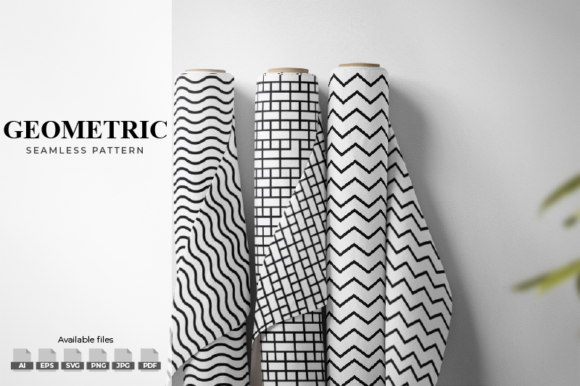
Geometric Art Seamless Patterns Design: A Process-Driven Asset for Modern Workflows
Geometric art seamless patterns design often appears in discussions as a purely decorative element. In practice, it is a functional, repeatable system that sits at the intersection of mathematics, brand strategy, and production efficiency. For professionals managing content, products, or brands, a well-executed geometric pattern is not merely a background. It is a modular asset that can scale infinitely, maintain visual integrity across applications, and reduce the overhead of creating bespoke visuals for every new touchpoint. Understanding how to plan, build, and integrate these patterns into a workflow transforms them from a time-consuming novelty into a reliable, high-leverage tool.
Moving Beyond Decoration: Patterns as Functional Assets
A seamless geometric pattern does not exist in isolation. It interacts directly with typography, photography, user interface elements, and physical substrates. This interaction is where its value emerges or collapses. A pattern that is too dense competes with foreground content. One that is too sparse fails to establish a cohesive visual environment. The design process must therefore start not with a single shape, but with a clear understanding of the job the pattern is required to perform. Is it creating a subtle texture for a website hero section, providing a vibrant backdrop for product packaging, or establishing a consistent visual rhythm across a slide deck? The answer determines the complexity, color palette, and scale of the geometry from the very first planning stage.
Integrating a geometric pattern into a workflow means treating it like any other foundational brand asset. It requires its own preparation, quality control, and documentation. When handled correctly, it provides a predictable and repeatable resource that marketing teams, content creators, and product designers can draw upon without needing to reinvent the visual language for every project.
Pre-Production: The Foundation of a Repeatable Pattern
The pre-production phase is where the majority of efficiency gains are determined. Rushing into shape creation without defining the structural constraints leads to patterns that are difficult to tile, inconsistent in appearance, or incompatible with their intended use case.
Defining Intent and Audience
Geometric patterns carry inherent psychological weight. Sharp, angular shapes communicate precision, innovation, and technology. Curved, interlocking geometries suggest fluidity, community, and organic systems. A pattern designed for a fintech dashboard requires a different geometric language than one intended for a children’s book publisher. Establishing this intent before opening the design software ensures that every line and angle serves a communicative purpose. For the entrepreneur or small business owner, this step aligns the pattern with the brand story. For the freelancer or agency, it builds a defensible design rationale that can be presented to clients.
Technical Groundwork
Compatibility begins with the right technical constraints. For digital use, choose a resolution-independent vector format. For print or textile applications, verify the required DPI and color mode early. A pattern built in RGB will not translate accurately to a CMYK print run without a color management step. Consider the repeat size. A small tile is efficient for file size and works well for compact surfaces like app icons or business cards. A larger, more complex tile is better suited for wallpaper, fabric, or wide digital backgrounds where visible repetition can feel cheap if the tile is too small.
- Tool Selection: Vector applications like Adobe Illustrator or Affinity Designer offer dedicated pattern creation tools and precise grid controls. For automated generation, tools like Processing or script-based plugins can produce complex variations from a set of defined rules.
- Color Constraints: Limit the palette before drawing. A 3-5 color palette with clear dominance and accent roles ensures the pattern remains cohesive and does not compete with layered content.
- Grid Systems: Decide on the underlying structure—standard grid, isometric, hexagonal, or brick. This structure dictates how individual motifs flow into one another and directly impacts the overall feel of the pattern.
The Construction Workflow: Precision and Efficiency
Building the actual pattern tile is a process of controlled repetition. The primary technical goal is creating a tileable block where all edges match perfectly. The secondary, and often more challenging, goal is ensuring that the internal composition does not create awkward gaps, clumps, or visible lines of repetition.
An efficient workflow relies on using the grid and alignment tools rigorously. Every element should snap to the underlying structure. When building the tile, place motifs that cross the tile boundary first, using the copy-and-paste technique (shifting a copy by the tile’s width or height) to verify alignment before proceeding to interior elements. This prevents the common failure point of discovering a misaligned seam after hours of detailing.
Workflow Example: Branding Assets for a Small Business
A boutique retailer requires a cohesive look for shopping bags, tissue paper, and social media highlights. The pre-production phase defines a palette based on the brand colors and a geometric style that reflects their modern, transparent manufacturing process.
Execution: A 10x10 cm tile is constructed in a vector editor using overlapping semi-transparent triangles and hexagons. The edge motifs are aligned using the transform tool to ensure seamless repetition. The completed tile is exported as an SVG for the website and a high-res PNG for print proofing.
Integration: The SVG is embedded in the website’s CSS as a background pattern, ensuring it scales perfectly on retina displays. The same file is imported into a page layout program for the bag mockup. The business owner now has a single asset file that serves multiple production channels, eliminating the need to recreate textures for each application.
Workflow Example: On-Brand Educational Materials
An educator or blogger prepares a series of workbooks and presentation slides. The need is for a background that is visually engaging but does not distract from core content.
Execution: A low-contrast, minimalist grid pattern is created using thin, monoline strokes. The tile size is large relative to the typical slide (e.g., 40x40 inches) to prevent tight, dizzying repetition on screen.
Integration: The pattern is set to multiply blend mode in the presentation software, adding a subtle architectural texture that overlays consistently across the slide master. This single action provides a professional, cohesive backbone for the entire deck, saving hours of manual background editing per slide.
Workflow Example: Web Interface Textures
For a developer or productivity-minded marketer, file size and load time are critical. A geometric pattern used for a landing page background must be optimized.
Execution: A simple dot grid or low-poly triangle pattern is constructed. The tile is kept small (100x100 pixels) and exported as a highly compressed PNG or directly as an SVG.
Integration: The pattern is applied via CSS to a container element. Using CSS, the developer can easily adjust the scale or opacity for different breakpoints without loading multiple image files. The pattern enhances the visual hierarchy without adding significant payload to the page.
Quality Assurance in Repetitive Systems
A seamless pattern requires a dedicated review cycle that differs from standard illustration work. The human eye is very good at spotting repetition, especially false seams or visual "rivers" that form when gaps align across repeats.
- The Offset Test: Create a copy of your tile and shift it by half the tile width and half the tile height. If the transition is visible, there is a seam. Adjust the edge elements until the overlap is imperceptible.
- Scale Analysis: View the pattern at the intended final output size. Then zoom out to 10% to simulate a large surface area. Check for unintended macro-patterns or clashing clusters that only become apparent with distance.
- Context Review: Place text or a UI element over the pattern. Is the contrast sufficient? Does the geometry interfere with readability at 1x, 2x, and 3x sizes? A beautiful pattern is useless if it degrades the functionality of the content it supports.
Common Pitfalls to Address
- Floating Elements: A shape that does not connect to anything creates a distracting void or a visible line of isolation. Ensure every element either touches another or has a clear spatial relationship defined by the grid.
- Inconsistent Stroke Weight: Uniform stroke weight across the pattern is critical. A thick line on one side and a thin line on the opposite side creates a visual imbalance that feels unprofessional.
- Ignoring Negative Space: The empty spaces between geometric forms are part of the pattern. If negative space forms an unintended shape (e.g., arrows, crosses, faces), it will compete with the intended design. Fill the negative space or structure it intentionally.
Building a Sustainable Pattern Library for Long-Term Use
The most significant productivity gain comes from treating completed seamless patterns as reusable assets rather than one-off deliverables. A curated pattern library reduces the start-up time for every new project. For a small business owner, this means consistent branding across seasonal campaigns without hiring a designer each time. For a freelancer or agency, it represents a valuable internal resource that speeds up client work and ensures a baseline of quality.
Organization: File naming and metadata are essential. Include details such as style (hexagonal, grid, organic), dominant colors, scale (micro, macro), primary use case (web, print, textile), and mood (energetic, calm, technical). Use a consistent folder structure or a digital asset management tool. When a marketing lead needs a "calm, blue, background for a Q1 landing page," the asset library should yield the correct pattern in seconds.
Consistency: Document the construction rules used for the patterns. Knowing that all patterns in the "Corporate" library use a 3-color palette and an 8-point grid allows for confident mixing and matching in complex layouts.
Licensing and Compliance: If the geometric motifs are sourced from third-party providers, maintain records of the license agreements. Ensure the license covers the intended commercial use, reproduction quantity, and distribution channels. This is critical for publishers and product-based businesses to avoid legal friction.
Geometric art seamless patterns design is a discipline that rewards process thinking as much as visual creativity. When approached as a repeatable system rather than an isolated graphic, it delivers consistent visual quality, supports brand recognition, and streamlines the production pipeline. The patterns do the heavy lifting of establishing atmosphere and structure, freeing the professional to focus on message, content, and outcomes. By investing in the planning, execution, and organization of these assets, you build a foundation that works across projects, platforms, and timelines.